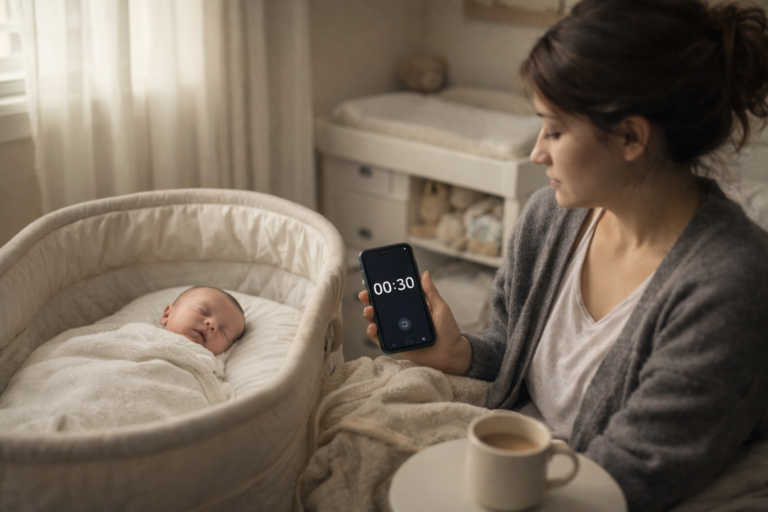
Newborn Day/Night Confusion: A 7-Day Reset Plan (That Doesn’t Require Perfection)

If your baby sleeps like an angel all day and then hosts a midnight talk show—welcome. You are not alone. Newborn day/night confusion is incredibly common because newborn circadian rhythms are still developing. In other words: your baby didn’t read the “nighttime is for sleeping” memo, and frankly, they’re too busy being brand new to care.
This post gives you a gentle, realistic 7-day reset plan using simple anchors—light, noise, routines, and boring night cues—without forcing wake windows like a drill sergeant.
Big picture sleep guide: Why Won’t My Newborn Sleep?
Sleep hub: Sleep & Nursery Essentials
What is newborn day/night confusion?
Day/night confusion is when a newborn:
- Sleeps longer stretches during the day
- Seems more alert or fussy at night
- Wants to feed frequently overnight (and then snooze happily in daylight)
It can look like:
- The “nap champ” baby from 9 a.m.–6 p.m.
- The “fully booked nightlife schedule” baby from 10 p.m.–4 a.m.
Important note: This is not your fault. It’s development.
Why newborns mix up day and night (it’s not “bad sleep”)
Newborns aren’t born with a functioning “clock” the way adults have. Several things are happening at once:
1) Their circadian rhythm is still under construction
The circadian rhythm is the internal system that helps your body know day vs night. In newborns, it develops gradually over the first weeks and months.
2) They came from a very different environment
In the womb it’s dark all the time. Baby’s “schedule” was basically: sleep → float → snack → repeat
Also, many babies are more active in the womb at night because your movement during the day gently rocks them—then when you stop at night, they notice.
3) Night feeds are biologically normal
Even when day/night confusion improves, newborns still need night feeds. The goal is not “sleep through the night”. The goal is:
- Longer night stretches
- More wakefulness during the day
- Nighttime being calm, boring, and predictable
4) Overtiredness can make nights worse
If daytime sleep is chaotic (short naps, lots of fussing), baby can become overtired—which often increases night waking and fussiness. Overtired help: Overtired Baby Signs: What to Do Tonight?
The two-anchors rule (what actually resets the clock)
If you do nothing else, focus on these two anchors:
- Daytime = bright + normal life
- Nighttime = dim + boring + consistent cues
That’s it. You’re teaching baby: Day is active. Night is quiet. White noise and steady sleep cues can help reinforce this pattern: White Noise for Babies
The 7-day reset plan (simple anchors, realistic goals)
Before you start: what “success” looks like
A realistic goal by day 7:
- Baby gets more light exposure during the day
- Nights are more boring and consistent
- Baby starts doing slightly longer night stretches (even 30–60 minutes longer counts)
- You feel more confident and less like you’re improvising every night
This is not perfection. This is direction.
Day 1: Set your “morning start” and “night start”
Pick two times:
- Morning start: when you want “daytime” to begin (example: 7–9 a.m.)
- Night start: when you want “night mode” to begin (example: 7–9 p.m.)
You don’t need strict schedules. You just need consistent signals.
Morning start routine (5–10 minutes)
- Open curtains immediately
- Speak normally (“Good morning!”)
- Feed in a bright-ish space
Night start routine (5–10 minutes)
- Dim lights
- Turn on white noise
- Keep voices low and minimal
Link your sleep cues to your nursery setup: Sleep & Nursery Essentials
Day 2: Make daytime bright on purpose
Light is one of the strongest circadian cues.
Daytime rules
- Open curtains / get daylight exposure
- Keep baby around normal household noise
- Do feeds in bright-ish light
If weather allows, a short daylight “lap” near a window or outside (brief, safe, supervised) can help. Don’t tiptoe during naps. You are not defusing a bomb. Normal living sounds are okay.
Day 3: Make nights boring (even if baby is awake)
Nighttime is not the time to teach, entertain, or start a new hobby. You’re building an association: Night = low stimulation
Nighttime rules
- Dim light only (think: enough to feed safely, not enough to “wake up”)
- Minimal talking (whispers or none)
- No playtime
- Keep diaper changes fast and calm
- Same sleepy cues every time (white noise helps): White Noise for Babies
If baby is wide awake but calm: that’s a “quiet awake” period, not a party.
Day 4: Add a gentle daytime rhythm (without forced wakefulness)
Many parents hear “keep baby awake during the day” and picture holding their newborn’s eyelids open like cartoon comedy. No. Instead, use gentle rhythm:
- After feeds, do 5–15 minutes of “daytime” (talking, looking around, tummy time if appropriate)
- Then allow sleep when baby shows cues
If baby naps very long stretches all day
- It’s okay to gently rouse for feeds if advised by your clinician
- Otherwise, you can nudge wakefulness with:
- diaper change
- fresh air by a window
- change of room
- a few minutes of interaction after feeds
Goal: More “day calories” and day alertness—without overtiring.
Day 5: Clean up the night feeds (make them smoother)
If night feeds are chaotic, baby wakes more fully and takes longer to settle. Build a “night station” so you can feed without turning on your full brain. Night station help: Night Feeding Setup
Night feed checklist
- Dim light ready
- Everything within reach (diapers, wipes, burp cloth)
- Keep baby close and movements slow
- Feed calmly, burp gently, return to sleep cues
If baby tends to wake when put down afterward, use the transfer strategy: The 7-step transfer method that actually helps
Day 6: Prevent overtiredness (because overtired babies throw midnight raves)
Overtiredness can look like:
- short naps that end cranky
- fussiness that escalates fast
- “second wind” alertness at night
If daytime sleep is poor, night can get worse. Treat naps as protection. Overtired help: Overtired Baby Signs: What to Do Tonight?
What to do
- Rescue at least one nap if needed (contact nap, carrier nap)
- Use consistent nap cues (dark-ish and white noise)
- Keep daytime awake time age-appropriate and gentle
Day 7: Hold the anchors, don’t chase a schedule
By day 7, don’t try to “perfect” everything. Keep the anchors:
Day anchor: Light, normal sound, normal life
Night anchor: Dim, boring, consistent cues
If nights improved even a little, keep going. Day/night learning is gradual.
What to do if baby is wide awake at 2 a.m?
This is the hardest part because you are tired and baby is… fully booked.
Keep the environment night-ish
- Dim light only
- White noise steady
- No bright screens if possible
Keep your response calm and boring
- Minimal talking
- Slow movements
- Gentle rocking if needed
If baby is content, allow “quiet awake”
You can hold baby, feed if hungry, and keep it low-stimulation. The goal is don’t teach their brain that 2 a.m. is daytime.
If baby escalates, reset basics
- Hunger? feed
- Gas? burp
- Diaper? quick change
- Too hot/cold? adjust
Then return to the same sleepy cues.
Troubleshooting (common reasons the reset feels stuck)
“My baby sleeps all day no matter what I do”
Start with the morning light anchor and keep daytime feeds bright-ish. Don’t force wakefulness harshly. Add small interaction after feeds.
“Nights got worse”
Often this is overtiredness. Make sure baby is getting enough daytime sleep, even if it requires a rescue nap. Overtired help: Overtired Baby Signs: What to Do Tonight?
“White noise doesn’t work”
White noise isn’t magic. It’s a consistent cue. If it helps even slightly, keep it steady. Tips here: White Noise for Babies
“Night feeds take forever”
Use a night station so you’re not turning on lights and searching for supplies while baby fully wakes. Night station help: Night Feeding Setup
FAQs
How long does day/night confusion last?
It often improves gradually over the first several weeks. Some babies shift quickly; others need more time. The goal is steady progress, not overnight transformation.
Should I keep my newborn awake during the day?
Generally no. Use light and rhythm rather than forced wakefulness. An overtired newborn often sleeps worse at night.
Does daylight help?
Yes. Daylight is one of the most effective natural cues for circadian development and helps teach the body what “daytime” is.
If my baby is awake at night, should I entertain them?
No. Keep it calm, dim, and boring. You’re teaching: “Night is quiet, even if we’re awake.”
What if nothing changes after 7 days?
Keep the anchors going and consider: Are daytime naps too short (overtiredness)? Are night feeds too stimulating? Is baby uncomfortable (gas/reflux)?
If you’re worried about feeding, growth, or persistent distress, check in with your pediatric clinician.
Need more help?
If you want the big-picture newborn sleep guide (and reassurance you’re not alone): Why Won’t My Newborn Sleep?
Sleep tools and gear that support calmer nights: Sleep & Nursery Essentials
White noise tips to reinforce night cues: White Noise for Babies