Minimalist Newborn Sleep Setup: What You Actually Need (Budget and Small Space)
You do not need a nursery that looks like a catalog. You need a safe sleep space and fewer regrets. This post is your permission slip to buy less—and sleep more.
Because newborn sleep is already unpredictable. You don’t need to add “I spent $600 on gadgets I hate” to the experience.
Big-picture newborn sleep guide: Why Won’t My Newborn Sleep?
Curated Sleep & Nursery picks hub: Sleep & Nursery Essentials
The minimalist goal (what we’re actually trying to solve)
A newborn sleep setup has three jobs:
- Safety: baby sleeps on a safe surface, in a safe position
- Consistency: the environment supports sleep cues (dark-ish, steady sound, predictable routine)
- Efficiency: you can handle night wakes and feeds without fully waking yourself (or the baby)
Minimalist doesn’t mean “bare”. It means:
- buy only what you will actually use
- keep the sleep space simple
- upgrade based on your real pain points
The true must-haves (what you actually need)
These are the core items that cover safety and basic function—without turning your room into a baby gear warehouse.
1) A safe sleep space (choose one)
You only need one primary sleep space to start.
Options
- Bassinet: great for newborn stage, often easier bedside
- Crib: works from day one if you want one-and-done
- Playard: versatile, especially for small spaces or multi-room use
Minimalist tip: Pick the option that fits your space and lifestyle, not the “trend”. The best sleep space is the one you can use consistently without wrestling it at 2 a.m.
2) Fitted sheets (2–3)
You don’t need a drawer full. You need enough for:
- one on the sleep surface
- one backup for a blowout
- one “I forgot laundry exists” emergency
3) A swaddle or sleep sack (depending on stage)
This depends on your baby and stage.
- Swaddle: helps many newborns with startle reflex and settling
- Sleep sack: wearable blanket; great for warmth and long-term consistency
Full guide here: Swaddle vs Sleep Sack: What to Use?
Minimalist tip: Don’t buy 8 types before baby arrives. Start with 1–2 options. Upgrade after you see what baby tolerates.
4) A dim light solution (optional but very practical)
Not required for safety—but highly useful for keeping nights boring and sleepy. You want a light that helps you feed/change without:
- blasting baby’s face with a phone flashlight
- waking yourself up like it’s morning
Minimalist tip: Warm, low, indirect light wins.
5) A simple “sleep cue” routine (free, but powerful)
This is the most underrated “item” in your setup:
- dark-ish
- steady sound (optional)
- same mini routine before sleep
- same response pattern at night
It costs nothing and does a lot.
Nice-to-haves that actually help sleep (pick based on your pain points)
These are upgrades that often improve sleep—not because they’re magical, but because they reduce disruptions.
1) White noise (high value for many families)
White noise can:
- mask household sounds
- support transfers
- become a consistent cue for naps and bedtime
But setup matters. Safe use and tips here: White Noise for Babies
Minimalist rule: One machine/app, one sound, consistent use. Don’t turn your nursery into a sound museum.
2) Blackout curtains (especially for daytime naps)
If you have:
- bright afternoon sun
- streetlights
- a baby who treats daylight as “party time”
Blackout can help naps stick. Not required, but often a strong “bang for buck” upgrade.
Minimalist tip: You don’t need designer curtains. Even a simple blackout panel can help.
3) Monitor (situational)
A monitor can be helpful if:
- baby sleeps in a different room
- you have a larger home
- you want peace of mind while you’re doing chores
If baby is in the same room and your space is small, you may not need it right away.
Minimalist tip: Don’t buy a monitor because someone said you “must”. Buy it when your setup makes it useful.
4) Humidifier (seasonal / situational)
Useful if:
- winter air is very dry
- baby seems congested
- you have forced-air heating
Not a universal must-have, but helpful for some families at certain times of year.
5) Extra sleep surface (only if needed)
Some families like:
- one bedside sleep space
- one “living room nap spot” (playard, portable bassinet)
In small spaces, this might be unnecessary. In multi-floor homes, it can save steps and sanity.
Skip-for-now (save your money)
These items often cost a lot and deliver little—especially before you know your baby’s temperament.
1) “12-hour sleep” miracle gadgets
If something promises a newborn will sleep like a teenager on a weekend, treat it like a late-night infomercial.
2) Excess bedding, positioners, pillows, “sleep nests”
These can create safety issues and are usually not needed. A safe sleep space is intentionally simple.
3) Buying 10 swaddles before you know what baby likes
Some babies love arms-down swaddles. Some hate them. Some want arms-up. Some break out of everything.
Start small. Learn your baby. Then buy strategically.
Read more: Swaddle vs Sleep Sack: What to Use?
4) Overcomplicated nursery setups
If you need to walk to three different places to feed, change, and settle baby, you’ve created a theme park. Minimalism is reducing steps and decisions at night.
Small-space layout tips (how to set up sleep without a nursery)
You can absolutely do newborn sleep in a bedroom, studio, apartment, or shared space. The key is layout.
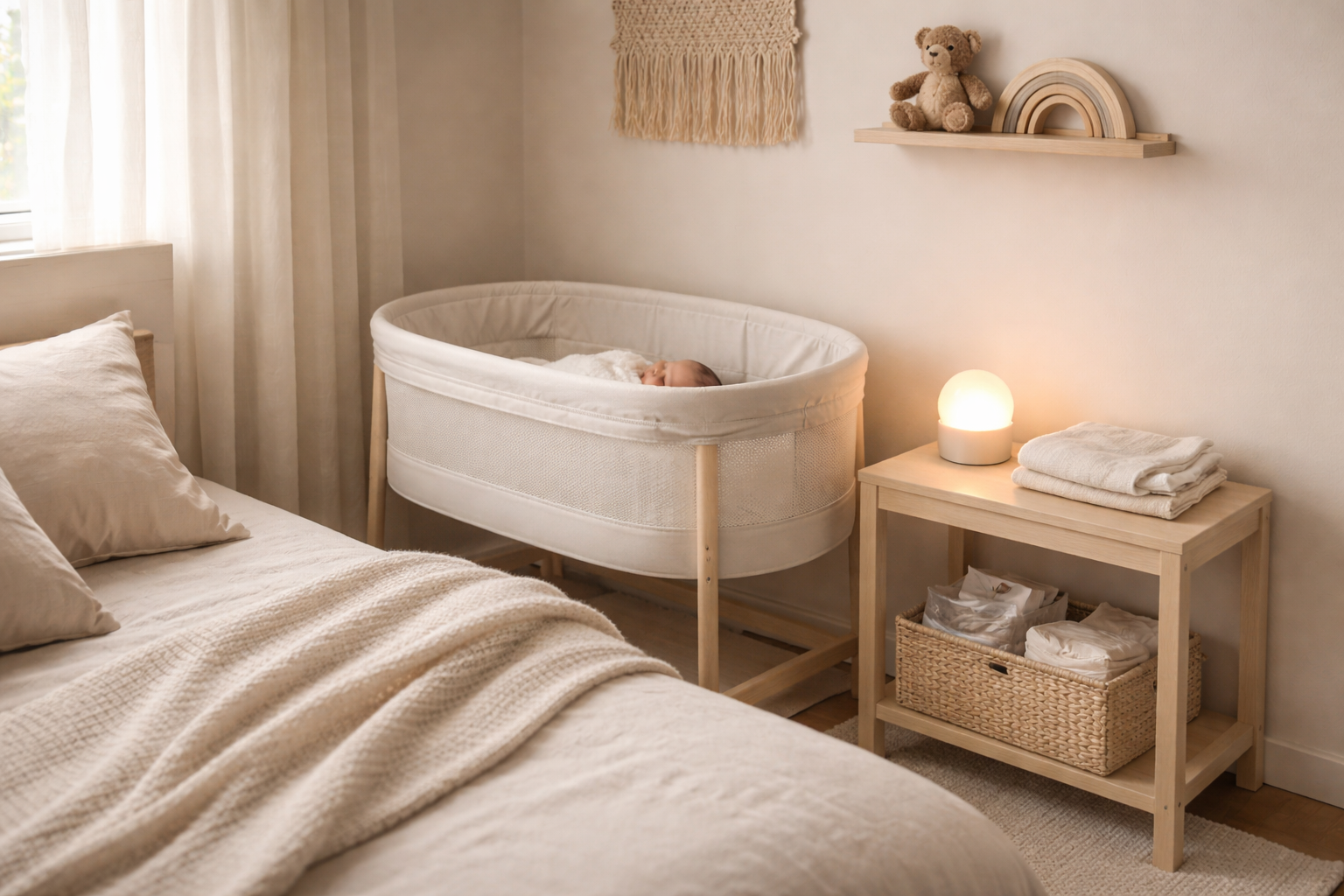
1) Keep sleep and diaper change close
At night, the enemy is walking. Walking wakes you up. Turning on lights wakes baby up. Searching for stuff wakes everyone up.
Simple layout
- sleep surface near your bed
- diaper caddy within a few steps
- feeding station within reach
2) Make one night station (this is the real MVP)
This is where minimalism becomes sleep. Build a “night feeding survival station” so you can handle wakes without turning on your full brain. Full night station setup here: Night Feeding Setup: The Newborn Survival Station That Saves Sleep
3) Store “night-only” items separately
Keep a small basket that only comes out at night:
- diapers/wipes
- burp cloth
- spare sleeper
- nipple cream if needed
- snack and water
This prevents you from rummaging through drawers like a raccoon at 3 a.m.
4) Reduce decisions
Every decision at night feels ten times harder:
- Where are the wipes?
- Which swaddle?
- Where is the pacifier?
- Why are there 14 tiny socks?
Minimalism = fewer choices. Fewer choices = faster back to sleep.
The 2-week rule (anti-overbuying strategy)
Here’s the simplest way to avoid regret purchases:
Buy the minimum.
Live with your baby for two weeks. Then upgrade based on your actual pain points.
Examples
- If daytime naps are impossible → blackout curtains might be your first upgrade
- If transfers fail constantly → focus on swaddle/sack, white noise, transfer routine
- If night feeds are chaos → build a better night station (often the best ROI)
- If you’re constantly worried → a monitor might help
Minimalist doesn’t mean “never buy anything”. It means “buy what solves a real problem you actually have”.
What’s the best first upgrade to improve sleep? (realistic answer)
If you want one “start here” improvement that helps most families:
- Night station efficiency (feeds and changes become boring and fast) → Night Feeding Setup: The Newborn Survival Station That Saves Sleep
- White noise set up properly → White Noise for Babies
- A swaddle/sleep sack that fits your baby’s stage → Swaddle vs Sleep Sack: What to Use?
Start with the one that matches your biggest pain point right now.
FAQs
Do I need a monitor right away?
Not always. If baby is sleeping in the same room and your space is small, you may not need one immediately. If baby sleeps in another room or you want peace of mind while doing things around the house, it can be useful.
Are blackout curtains worth it?
Often yes—especially for bright rooms or daytime naps. They’re not required, but they can make naps more consistent for many babies.
What’s the best first upgrade to improve sleep?
Usually the upgrade that reduces disruption the most:
Night station (less chaos at feeds)
Properly set up white noise (better cue + fewer startles)
Correct swaddle/sleep sack for stage (less startle, better settling).
Related Reads
For the big-picture newborn sleep guide: Why Won’t My Newborn Sleep?
For curated Sleep & Nursery picks and essentials: Sleep & Nursery Essentials
Swaddle vs sleep sack guidance: Swaddle vs Sleep Sack: What to Use?
White noise safe setup: White Noise for Babies
Night feeding station that saves sleep: Night Feeding Setup: The Newborn Survival Station That Saves Sleep