Night Feeding Newborn: Easy Setups, Partner Shifts, and Faster Back-to-Sleep Tips

Night Feeding With a Newborn: The Olympics, But With Less Applause
Night feeds are where time gets weird. You can do a full feed, a diaper change, two burps, and a tiny pep talk… and somehow it’s still 1:12 a.m. again.
If your nights feel like:
- wake → feed → settle → almost sleep → baby wakes again
- repeat until you start narrating your life like a nature documentary
You’re not doing anything wrong. Newborns eat at night. That’s normal. The goal is not to “win” night feeds. The goal is to make them:
- calmer
- simpler
- faster to recover from
- less disruptive to your sleep (as much as biology allows)
This post gives you a practical system for night feeding newborn life:
- a simple feeding station setup
- realistic partner shifts
- technique tweaks that reduce gas and wakeups
- and ways to get yourself back to sleep faster
Start at the feeding hub: Feeding Hub
Newborn feeding basics: How to Survive Newborn Feeding Without Losing Your Mind?
Bottle technique help (paced feeding, nipple flow): Bottle Feeding Basics
If your worry is “Is baby eating enough?”, read “Is My Baby Eating Enough?”
The Core Night Feed Rule: Make Night Boring
Your newborn’s brain is learning day vs night. Your job is to make night feeds:
- low light
- low interaction
- low stimulation
- high efficiency
- and (ideally) not an accidental party
Night = “we do the thing, we go back to sleep”
Day = “we’re social mammals”
The Three Night Feed Problems You’re Solving
- Too much setup time (where are the wipes? where is the nipple? who took the charger?)
- Too much stimulation (bright lights, talking, phone scrolling, and suddenly baby’s wide awake)
- Too long to resettle (gas, diaper drama, overtired baby, overtired parent)
So everything below is about reducing friction.
Feeding Station Setup: Your 2 a.m. Command Center
This is the conversion-friendly magic. A feeding station doesn’t add work—it removes 45 tiny decisions. Choose one location (don’t make yourself travel). Pick:
- bedside
- nursery chair corner
- couch corner
- anywhere you can feed without waking the whole house
Then keep the supplies there all the time.
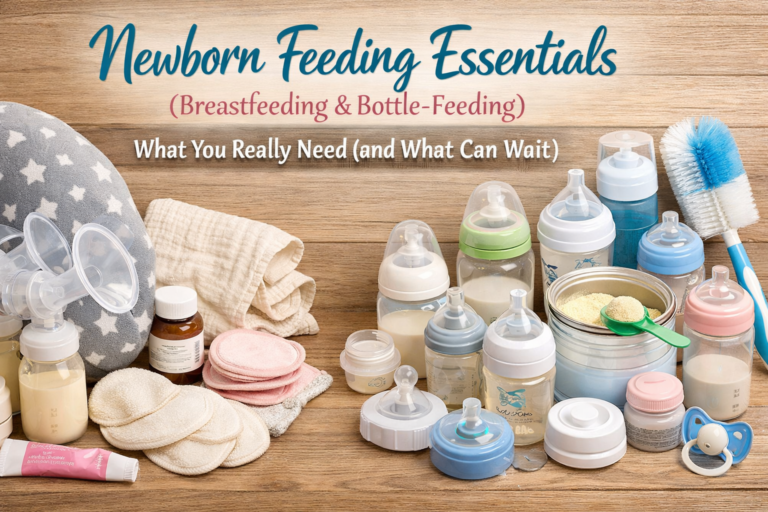
The “Simple” Night Feeding Station Checklist
Must-haves
- dimmable night light (or tiny lamp)
- burp cloths (2–3)
- diapers, wipes and diaper cream
- extra onesie/sleeper (for surprise events)
- water bottle and snack for you
- phone charger (long cable)
If bottle feeding (formula or expressed milk)
- 2–3 clean bottles with nipples and caps
- slow-flow nipples (especially for newborns)
- pre-measured formula or ready-to-feed (if using)
- a small cooler bag or mini-fridge access (for stored milk—follow safe storage guidance)
- bottle basics guide for pacing/flow: Bottle Feeding Basics
If nursing
- pillow support (or whatever saves your back)
- nipple balm (if you use it)
- nursing pads (optional)
- a swaddle/sleep sack ready nearby (if appropriate for age)
Optional sanity boosters
- small trash bag or bin (wrappers, wipes)
- hand cream (night washing is brutal)
- a notebook/app for tracking (if it helps you—not if it makes you spiral)
Pro tip: Put everything in one caddy/bin so it’s “grab-and-go” and not a “scavenger hunt”.
Parts-Drying Workflow (So You Don’t Hate Mornings)
If you’re bottle feeding or pumping, the real enemy isn’t the feeding—it’s the constant washing. Simple workflow:
- Have one dedicated drying rack near the sink.
- Have a wash basin so parts don’t swim around the sink.
- Keep two sets of nipples/parts if possible (so you’re not stuck waiting for things to dry).
This reduces midnight panic like: “We have no clean nipples” (a sentence that should never exist).
Night Feed Tips That Actually Help Baby (and You) Go Back Down
1) Light: Dim enough to stay sleepy
Use the smallest light that lets you see:
- latch/bottle angle
- diaper situation
- milk amount
You’re aiming for “cozy cave” not “interrogation room”.
2) Don’t fully change baby unless you have to
If baby is calm and diaper isn’t poop, you can often:
- feed first
- then do a quick check/change if needed
Poop? Change before or midway to avoid a wakeful mess later.
3) Keep voices minimal
You can absolutely comfort your baby—just keep it low-key:
- soft shushing
- gentle pats
- no big conversations
- no “WHO’S MY CUTIE?” speeches (save those for daylight)
4) If bottle feeding: Paced feeding is your best night weapon
Fast bottles can lead to:
- more air
- more spit-up
- more wakeups
- more “why are we still awake” moments
Use paced feeding and slow-flow nipples. Full guide here: Bottle Feeding Basics
5) Burp strategically (not endlessly)
Night burping doesn’t need to be a 25-minute performance. Try:
- one burp break mid-feed
- one after feed
If baby is comfortable, don’t force it.
6) Upright “digest” time (short and calm)
A brief upright hold can reduce spit-up discomfort. Aim for 5–15 minutes if baby tolerates it.
Partner Shifts: The Most Powerful Sleep Hack
If you have a partner (or support person), shifts can change your life quickly. The goal of shifts is not “perfect equality”. It’s each adult gets one real stretch of sleep.
Shift Model A: Split the night in halves
- Partner A: 9 p.m. – 2 a.m.
- Partner B: 2 a.m. – 7 a.m.
One person handles feeds/diapers in their window (with bottles or bringing baby to nurse).
Shift Model B: Partner handles everything except nursing
If you’re nursing:
- Partner gets baby, changes diaper if needed, brings baby to you
- You feed in bed (as calmly as possible)
- Partner burps/settles and returns baby to sleep
This still counts as a shift because your job becomes “feed only”, not “feed and manage everything”.
Shift Model C: One bottle feed nightly (combo plan)
- Choose one feed nightly for a bottle (pumped milk or formula)
- The other adult takes that full feed
- You sleep through it
If you want combo feeding strategies, see Combo Feeding Newborn
For formula feeding guidance, see Formula Feeding Without Guilt
Faster Back-to-Sleep: The Parent Side (Yes, You Matter Too)
Sometimes baby goes back down and you don’t. Classic.
1) Don’t “reward yourself” with your phone
It feels like a treat. It is a trap. If you can, keep the room boring:
- no social media
- no email
- no “just checking one thing”
2) Warmth and comfort wins
- keep a blanket nearby
- keep socks on (being cold keeps you awake)
- keep water within reach so you don’t go hunting
3) Use a “shutdown script”
When you lie back down, repeat a short phrase:
- “Baby is fed. Baby is safe. I can rest now”
It sounds corny. It works because it gives your brain a finish line.
4) If you’re anxious about intake
This is where spirals happen at night. Go to our reassurance anchor in daylight hours (or bookmark it): “Is My Baby Eating Enough?”
“Is This Amount of Night Feeding Normal?”
In the newborn stage, night feeding is normal and protective against low intake. Babies often feed every 2–3 hours (sometimes more often during growth spurts). If you’re worried baby isn’t eating enough, use your data anchors:
- wet diapers
- weight trend
- alertness
Start here: “Is My Baby Eating Enough?”
When to Talk to Your Provider
Contact your provider if:
- baby is very hard to wake for feeds
- diaper output is low
- weight gain is a concern
- vomiting is forceful or green
- you feel something is off
- you’re feeling emotionally unsafe or extremely overwhelmed (this matters)
Quick Night Feed Troubleshooting
Baby wakes fully and won’t resettle
Try:
- dim lights even more
- shorter interaction
- check for gas (brief burp, upright hold)
- ensure diaper isn’t uncomfortable
- avoid extra bouncing/jiggling that becomes a “sleep requirement”
Baby falls asleep mid-feed then wakes 20 minutes later
Try:
- paced feeding for bottles
- keep baby slightly more awake during feed (gentle foot rub, switch sides)
- ensure a full feed (not just comfort sips)
Baby is gassy at night
Try:
- slower flow nipple and paced feeding: Bottle Feeding Basics
- more burp breaks
- upright hold after feed
- avoid overfeeding (pause, watch cues)
FAQs
How often should a newborn feed at night?
Many newborns feed every 2–3 hours, sometimes more often during cluster feeding or growth spurts. Your provider will guide you if weight gain is a concern.
What is the best night feeding setup?
A simple feeding station: dim light, diapers/wipes, burp cloths, water/snacks, and bottle supplies (if needed) in one spot.
How do partner shifts work with breastfeeding?
Partners can handle diapering, bringing baby to you, burping, and settling back to sleep. You do the feeding; they do the rest.
How can I get my newborn back to sleep faster after feeding?
Keep lights low, keep feeds calm and paced, burp briefly, do a short upright hold, and avoid extra stimulation.
Should I change diapers at every night feed?
Not always. If it’s poop, yes. If it’s just pee and baby is calm, you may be able to feed first and change only if needed.
I’m worried my baby isn’t eating enough at night—what should I watch?
Wet diapers, weight trend, and baby’s alertness/satisfaction. Use the reassurance checklist here: The 3 Best Indicators Baby Is Eating Enough
Related Reads
For all newborn feeding topics and guides, start at the feeding hub: Feeding Hub
For newborn feeding cues and what’s normal, read: Feeding Stress Is Real
For paced feeding and nipple flow (huge for night feeds), see: Bottle Feeding Basics
Worried baby isn’t eating enough? Use the diaper and weight reassurance guide: The 3 Best Indicators Baby Is Eating Enough